I Made AI Build an IRR Model
I asked Claude and Copilot to build a real estate return model, then checked both against my own. The output was polished. It was not always correct.
In the first installment of this series, my partner Eli broke down cap rates and walked through a useful concept: if your cash flow grows at a constant rate and you buy and sell at the same cap rate, your unlevered return will be exactly the cap rate plus that growth rate. Clean formula. Easy to remember.
I wanted to prove it. So I built a return model in Excel, ran the math, and confirmed it works.
Then I thought: let me see if AI can do the same thing. I tested both Claude (Anthropic's AI) and Copilot (Microsoft's AI), built my own version in Excel as a benchmark, and put all three side by side. The results were mixed.
Presentation and polish
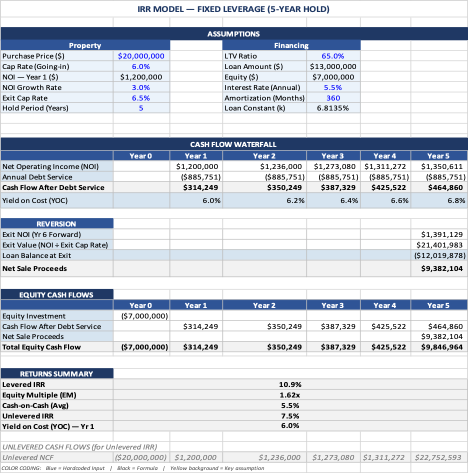
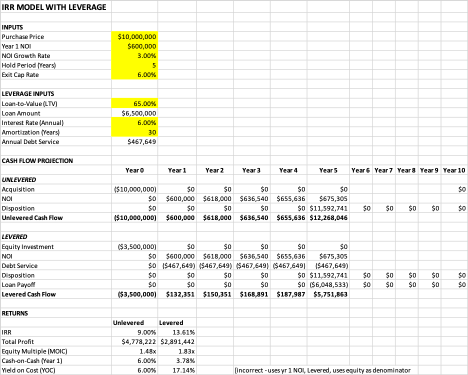
Both AIs built clean, dynamic models with separated input areas, distinct formatting for assumptions, and organized output sections. On pure presentation, Claude was the clear winner. More polished layout, more intuitive structure, and more flexibility with respect to input assumptions. Copilot was functional, but comparatively basic.
If I showed you Claude's model and mine side by side without telling you which was which, you'd pick the AI version as the more professional one. No question. Copilot, however didn’t do as well. My model presented way better than Copilot's.
Claude’s Model
 View full size ↗
Copilot’s Model
 View full size ↗
The simple test: unlevered returns
Both AIs passed. Given a going-in cap rate, a constant growth rate, and a matching exit cap rate, both correctly calculated the unlevered IRR and confirmed it equals the cap rate plus the growth rate. So far, so good.
Pushing further: levered returns and additional metrics
Here's where things got more interesting. I asked both AIs to expand the model and solve for cash-on-cash return, equity multiple, and yield-on-cost on both a levered and unlevered basis.
Claude handled all of it without issues. Copilot got the unlevered metrics right but made a significant error on the levered side: it miscalculated yield-on-cost by using equity in the denominator rather than total cost. That's not a rounding difference. That's a fundamental misunderstanding of the metric.
One other detail worth noting: both AIs defaulted to calculating un-trended yield-on-cost, which is standard. But Claude went a step further and offered to calculate a stabilized YOC, correctly identifying the stabilization year based on the cash flow trajectory and hold period. Small thing, but it showed a level of contextual awareness that Copilot didn't match.
Model validation (this was the surprise)
I flipped the exercise and asked both AIs to validate my model instead of building their own. My model included a leverage sensitivity table with multiple debt scenarios.
Claude handled it perfectly. Copilot missed one of the leverage scenarios in the sensitivity table entirely. When I pointed out the mistake, Copilot insisted it hadn't missed anything. It took me calling the output "seriously flawed" before it corrected itself and apologized. Not exactly confidence-inspiring.
But here's the part I didn't expect: I then ran my model with an intentional error baked into the cash flows. Both AIs caught it. Both recognized that the figures were inconsistent with my stated growth assumptions and offered to fix it. That was genuinely impressive, and it's where I see the most practical value for AI in real estate today. Model validation is a real use case.
Where it got tricky
I found Claude to be the more capable tool overall, so I pushed it further and asked it to handle variable hold periods. It did this correctly. But it also quietly changed the exit cap rate, bumping it up 50 basis points from the going-in rate. In practice, that's reasonable underwriting (you typically assume some cap rate expansion at exit). But for this exercise, it breaks the proof. The whole point was to show that the IRR equals the cap rate plus the growth rate, and that only holds when the going-in and exit caps match.
This is a nuance that requires understanding why you're building the model, not just what the model needs to do. AI handled the "what" on the second pass. It missed the "why."
Interestingly, Eli ran a similar exercise on his end and hit a different set of errors entirely, which tells you something about the variability of AI output even on the same assignment. Worth exploring in a future post.
The honest scorecard
Did AI save me time? Not really. Between prompting, reviewing, catching errors, and re-prompting, it took roughly as long as building the model myself.
Was the output better-looking? Yes, significantly. Claude's formatting and presentation were a clear step above what I produced manually.
Would I use it again? If I needed to build this model fifty times with different assumptions for fifty different properties, and I had the prompt dialed in to produce the right output, AI would crush it. The speed advantage on repetitive execution is real. The challenge is getting the prompt to the point where it produces correct output every time, because you can't rely on it to catch its own financial logic errors.
Would I use it for model validation? Absolutely. That was the most immediately practical takeaway from this exercise.
What this means if you're an investor or allocator
If you're a family office or advisor evaluating GPs who claim to be using AI in their underwriting, ask them this: who checks the model?
AI can produce a polished financial model faster than any analyst. But “polished” and “correct” are not the same thing. The errors Claude made weren't obscure edge cases. The matching going-in and exit cap rate assumption is day-one real estate finance. Any junior analyst who made that mistake would get sent back to fix it.
The firms using AI effectively aren't replacing financial judgment with it. They're using it to accelerate the mechanical work, validate existing models, and then applying human expertise to confirm the output. This distinction is key.